
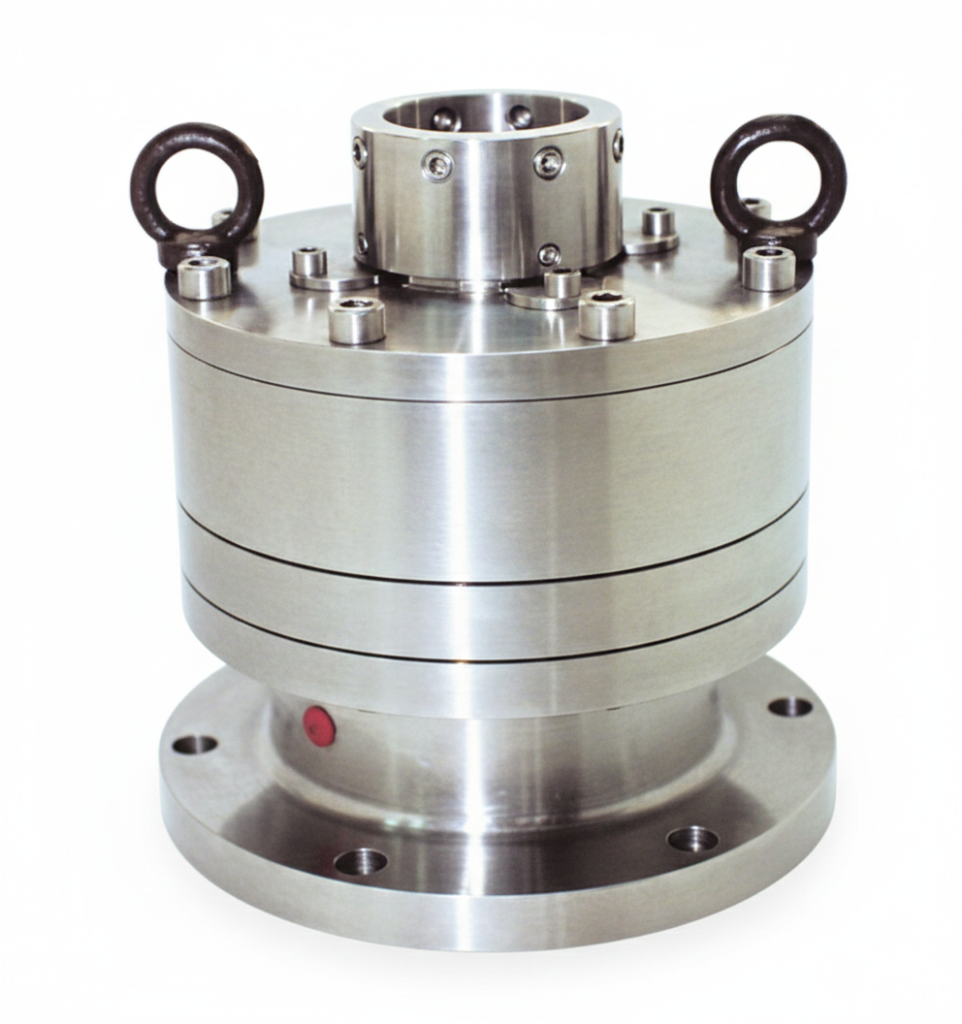

Agitator Seals are specialized mechanical seals designed for mixers, agitators, and reactors where a rotating shaft enters a vessel containing liquids, slurries, or chemicals. Their primary function is to prevent leakage of process fluids while maintaining pressure, sterility, or vacuum inside the tank.
Key Features
Designed for vertical or top-entry shafts
Withstand continuous mixing loads and vibration
Suitable for corrosive, hazardous, or sterile fluids
Operate under pressure or vacuum conditions
Available in single or double seal configurations
Compatible with flushing or barrier fluid systems
How It Works
Two precision-engineered faces (rotating and stationary) are pressed together to form a tight seal. In many applications, a barrier fluid system lubricates and cools the faces while preventing process fluid from escaping.
Typical Applications
Chemical reactors Pharmaceutical manufacturing Food & beverage processing tanks Paint and coatings production Petrochemical vessels Biotechnology and sterile mixing systems Waste treatment reactors
Main Components
Rotary Seal Face — attached to the agitator shaft Stationary Seal Face — fixed to the seal housing Gland Plate / Housing — mounts seal to vessel Springs or Metal Bellows — maintain face pressure Elastomers (O-rings) — provide secondary sealing Barrier / Flush Ports — for cooling and lubrication
Advantages
Prevents leakage of hazardous or valuable fluids Maintains process purity and sterility Handles shaft misalignment and vibration Reliable under pressure or vacuum Reduces maintenance and downtime
This is the heading
Lorem ipsum dolor sit amet, consectetur adipiscing elit. Ut elit tellus, luctus nec ullamcorper mattis, pulvinar dapibus leo.
This is the heading
Lorem ipsum dolor sit amet, consectetur adipiscing elit. Ut elit tellus, luctus nec ullamcorper mattis, pulvinar dapibus leo.
This is the heading
Lorem ipsum dolor sit amet, consectetur adipiscing elit. Ut elit tellus, luctus nec ullamcorper mattis, pulvinar dapibus leo.